
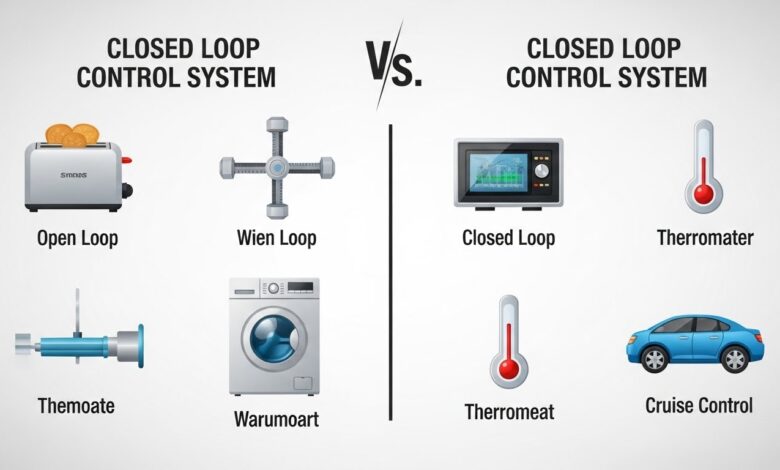
Control systems are vital for automating processes in various fields, ranging from manufacturing to automotive engineering. Understanding the differences between closed loop and open loop control systems is essential for choosing the right approach for specific applications. This guide will break down the key characteristics, advantages, and real-world examples of both systems.
What is an Open Loop Control System?
An open loop control system is a type of control mechanism that functions without feedback. In this system, the input is converted into a specific output without any monitoring or adjustment based on the output’s actual performance. The control action is initiated by the controller’s input, and once the output is produced, the system does not take further corrective actions.
Key Features of Open Loop Control Systems:
- No Feedback: Decisions are made without feedback about the output performance.
- Simplicity: Generally simpler in design and easier to implement.
- Cost-Effective: Often less expensive due to limited complexity and components.
- Predictable: Operates under the assumption that inputs will always produce the expected outputs.
Examples of Open Loop Control Systems:
- Washing Machines: These machines run through predefined cycles without adjusting based on laundry cleanliness.
- Toaster: A toaster operates for a set duration, regardless of the toast’s actual browning level.
- Traffic Lights: Fixed timing for red, yellow, and green lights without considering real-time traffic conditions.
What is a Closed Loop Control System?
A closed loop control system, on the other hand, uses feedback to adjust its operation. In this system, the output is continuously monitored, and adjustments are made based on this feedback to maintain desired performance levels. The controller receives input from the output and makes necessary adjustments to ensure that any deviations from the desired output are corrected.
Key Features of Closed Loop Control Systems:
- Feedback Presence: Uses output data to inform and adjust the system.
- Complexity: Generally more complex than open loop systems, requiring additional components.
- Higher Accuracy: Adjustments based on real-time data lead to improved precision.
- Adaptability: Can respond to changes in the environment or system performance.
Examples of Closed Loop Control Systems:
- Thermostats: Smart thermostats adjust heating and cooling based on feedback about room temperature.
- Cruise Control in Vehicles: This system maintains a set speed by adjusting the throttle based on feedback from the vehicle’s speed.
- Automated Manufacturing Systems: These systems adjust production parameters based on real-time quality monitoring.
Key Differences Between Closed Loop and Open Loop Control Systems
| Feature | Open Loop Control System | Closed Loop Control System |
|---|---|---|
| Feedback | No feedback mechanism | Utilizes feedback for adjustments |
| Complexity | Simple and direct | More complex due to feedback mechanisms |
| Cost | Generally lower cost | Typically higher cost |
| Accuracy | Less accurate due to lack of adjustments | More accurate due to continuous feedback |
| Application Examples | Appliances, timers | Climate control, automated machinery |
Conclusion
Choosing between a closed loop and an open loop control system depends on the specific requirements of the application at hand. Open loop systems are advantageous for simpler tasks where precision is less critical and costs need to be minimized. In contrast, closed loop systems offer enhanced accuracy and adaptability, making them suitable for complex applications requiring ongoing adjustments. Understanding these differences can guide you in selecting the most suitable control system for your needs.